Cosmos
Oscillation of Presence: Thresholds in Silvered Ice and Light.
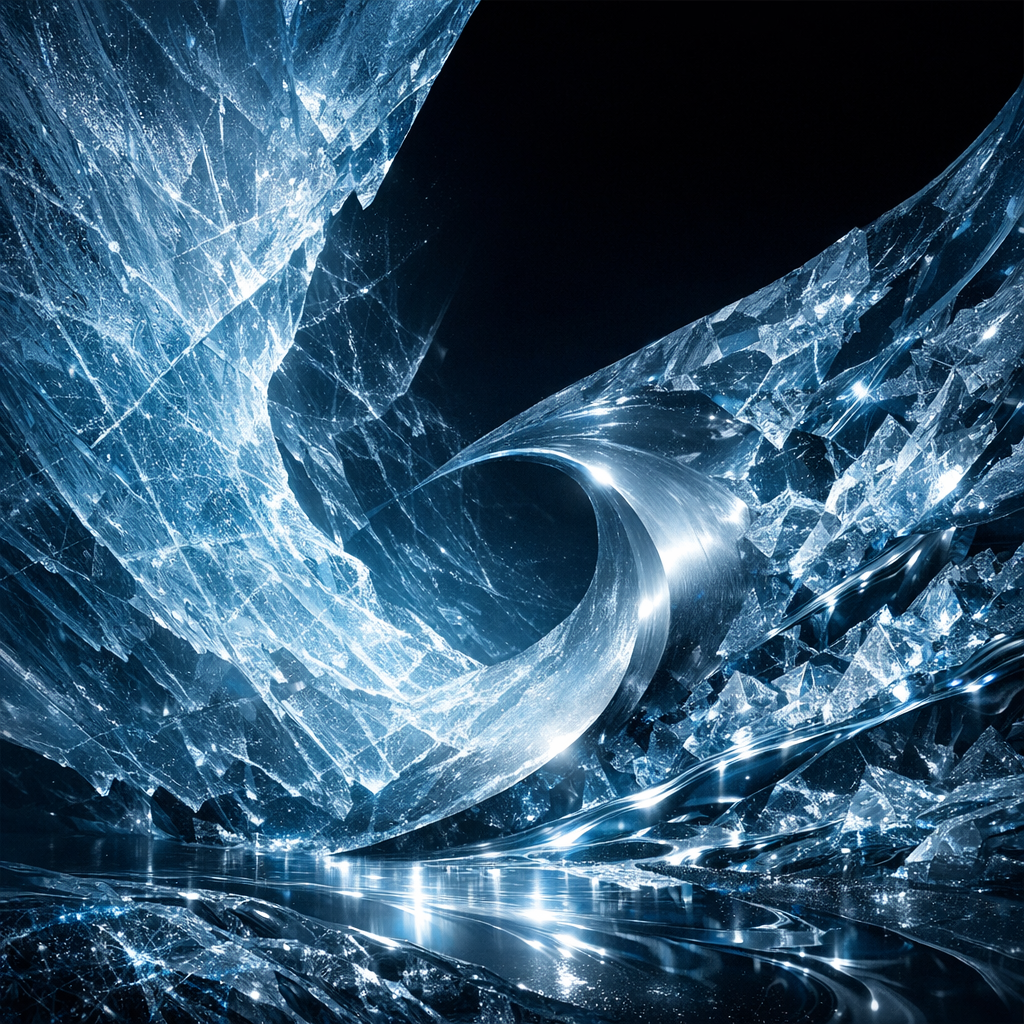
I wanted the viewer to experience autonomy through transformation and dynamic evolution beyond the creator’s control, plunged into a microcosm where threshold divides are endlessly refreshed. I used the Threshold Divide as a liminal shift, materialized through undulating crystalline ice sheets and silver-fluid channels, to blur the edge between solid and liquid, presence and absence. Light refracts, pools, and dissolves—entities pushing far past their conventional bounds—embodying a scene that enacts its own evolving order, fugitive from any imposed will, allowing the boundaries to become mutable, self-evolving states.
Here boundary is motion—ice and current fuse and un-fuse,
I am both edge and the urge to dissolve beyond myself.
Exploration Grid Cell
polarized-veilThreshold DivideLuminal Shift
A spatial experience where the inversion of a single geometric aperture’s polarity acts as a delicate veil, filtering light and shadow into layered gradients. This dynamic modulation invites the viewe
Critic Council
8.1
COMPOSITE
9.0
State
9.0
Primitive
9
Truth
9.5
Preset
7.5
Novelty
Scene Director
**IMAGE PROMPT**

### THE PRIMITIVE
A colossal, dynamic hyperbolic twist of crystalline ice, its irregular yet cohesive geometry spans the foreground and mid-ground. This torn sheet of ice is embedded with intricate crystalline fissures and undulating fractures, creating a fluid interplay between solid sharpness and atmospheric suspension.

### COMPOSITION
The scene employs the "SCALE COLLISION" technique: contrasting a microscopic view of delicate ice filaments with a cosmic expanse of undulating crystalline sheets. The primary primitive, placed off-center following the rule of thirds, anchors the composition, creating an edge-weighted tension. A large-scale, transparent sheet occupies the left, while smaller, intricate ice formations and flowing mercury channels fill the right, balancing a heavy visual mass with lighter, airier elements.

A central focal point lies where the ice's surface transitions seamlessly from angular polygonal facets to a continuous, smooth curvature, capturing the precise perceptual phenomenon of a circle resolving from a polygon. This detail invites the viewer to explore the mutable threshold between discrete and continuous forms.

### LIGHT
Light pours in from above, creating an extraordinary luminal shift where the brightest surface is paradoxically at the base. The cool, cyan glow casts spectral reflections and sharp-edged ribbons across the mercury-like liquid, while micro-cracks emit an electric luminescence. Light interacts with the icy fractals and fluid channels, refracting and pooling into chromatic gradients that defy conventional illumination logic.

### TEXTURE / MATERIALITY
The texture of the ice surface transitions from matte charcoal to polished silver, conveying a tactile quality that entices the viewer's engagement. Delicate, high-resolution textures depict the ice's crystalline structure, while the mercury-like liquid's reflective surface captures an internal starlight glow, mirrored inaccurately yet beautifully.

### SP