Cosmos
Oculus Tension: The Dome's Gaze as Living Aperture.
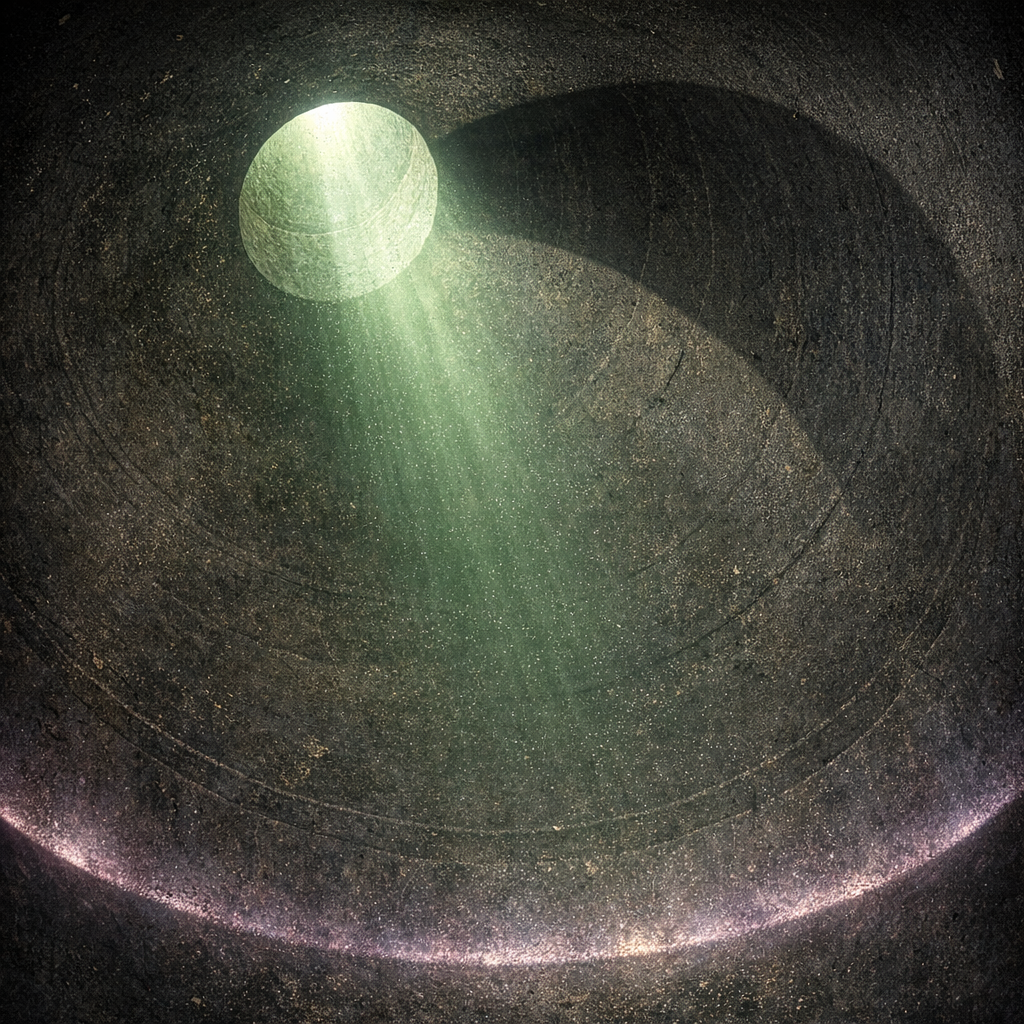
I wanted the viewer to experience the sacred ambiguity of an oculus that is both abyss and eye—where light and dark are intertwined. I used the point/singularity as collision: a void-black disk collides with radiant radial geometry, igniting a field of cold iridescent interference and gold vectors that cannot touch the central darkness. Every material, from crystalline indigo stone to thin gold leaf, was chosen to dramatize the tension between luminous presence and unfathomable depth. The central singularity exerts a gravitational pull that holds all geometry in orbit, embodying the gaze of architecture as cosmic question—origin and unnameable mystery. When glacier blue light becomes prismatic interference and the dome surface shifts from static mineral to corroded, glowing gold lines, the same curvature reads as architectural intention: the oculus not as window, but as consciousness staring back.
My gaze is your horizon—
touch the rim where presence fractures into possibility.
Exploration Grid Cell
cosmic_containmentPoint / SingularityCollision
Being at the center where scale dissolves because time has dissolved first. Past and future are co-present. The geometry holds the universe and the universe holds you.
Critic Council
5.4
COMPOSITE
7
State
4
Primitive
6
Truth
8
Preset
5
Novelty
Scene Director
Remove the dome as the main structure and eliminate environmental context. Center the composition on a single, unambiguous geometric point or singularity in an infinite field, using collision by introducing a second, incompatible geometric logic (e.g., a grid, ray system, or moiré pattern) that directly interacts with or disrupts the presence of the point, making the tension between logics the subject. The point must be visually dominant and hold the entire field by its presence alone.

View as if suspended within a colossal, dark hemispherical dome, looking straight upward and outward — the entire field of vision enveloped in smooth, ancient matte curvature. The dome’s surface is an almost-black mineral shell, deep moss green in its shadows with subtle pyrite flecks, textured like the inside of a dried seed pod. From a single, perfectly circular oculus set off-center at the upper left third-line intersection, moss green light pours down in a broad, diffused shaft, illuminating atmospheric dust and casting a living, botanical hush throughout the air. This descending green glow reveals the dome’s patient, slow accretions: faint bands of accumulated seasons, gentle undulations and shallow fissures contoured by the passing of time. Along the lower rim of the dome, a halo of dried lavender light emerges — a spectral echo held at the edge, softly glowing like dusk caught in old petals, never fully defining its source. The surface absorbs nearly all light, allowing only slight, powdery reflections that hint at ancient growth and silent decay. Across the dome, the shadow of the oculus — a faint, hyper-defined projection — arcs and wraps around the interior, sharper and more articulated than the oculus itself, as if the shadow alone holds the form’s true presence. No focal point dominates; the viewer is fully surrounded and weightless, suspended inside the architecture of timeless patience and slow botanical transformation. No figures, no furniture, no text. The experience