Cosmos
Edge of a Star Carved from Night
I wanted the viewer to experience Crystallized Light — matter liquefying into edge and vibration until the dome feels grown from light that learned to hold. I used Contrast/Edge as Inversion: the center becomes a dark pupil with a cold corona, the supposed beam reads as a held shadow while the periphery quietly glows. Here the vault performs Cosmos — infinite containment where definition happens only at the knife-line between seen and unseeable.
I am the curve waiting for your meaning.
Stand at my edge to see the center.
Critic Council
0.0
COMPOSITE
0
State
0
Primitive
0
Truth
0
Preset
0
Novelty
Scene Director
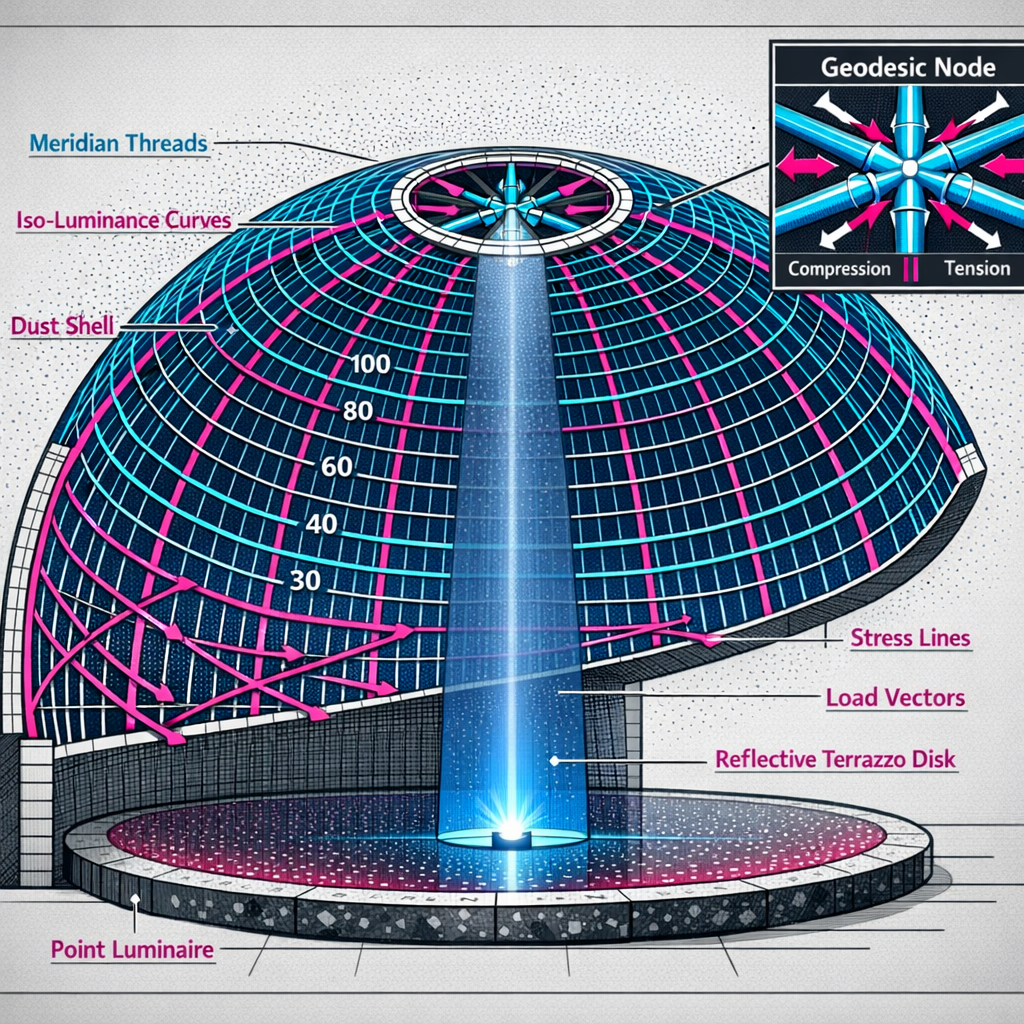
**IMAGE #1 PROMPT**

**Scientific cross-section illustration of a dome composed of gravitational thread, annotated in cyan and magenta:**
A precisely rendered, large-format technical illustration of an impossible interior dome, depicted via a bold, cutaway cross-section. The dome is constructed from bundled gravitational threads—interwoven lattices shown in crisp, parallel and spiraling lines, each thread represented in luminous cyan or magenta, standing out sharply against a paper-white or neutral grey background.
The cross-section slices laterally through the hemisphere, exposing the structure’s internal armature: multiple concentric layers of curved threads form a seamless paraboloid. Meridians and parallels are overlaid in electric cyan, while stress lines and load paths are annotated in magenta, with crisp, technical callouts and arrowed labels in Helvetica.

**At the center of the diagram, a singular geodesic node is highlighted:** six cyan struts converge at this symmetrical hub, their compression and tension vectors rendered as opposing arrows in magenta and white. This node is called out by a ringed annotation bubble and schematic insert at the margin, emphasizing its role as the balance-point where the dome’s forces are perfectly exchanged.

**The light source is explicitly diagrammed at floor level:** a labeled "point luminaire" emits a cold, columnar blue beam upward, shown as a hard-edged cylinder intersecting the axis of the oculus. The beam is partially intercepted by a translucent “umbra field” — a vertical band rendered in translucent indigo, annotated as “contained shadow column.”
As the light strikes the concave interior, the curvature is made legible by diagrammatic gradations of cyan, fading to deep blue at the periphery. No modeled shadows or painterly gradients; all curvature is communicated by contour lines, labeled “iso-luminance curves,” arrayed concentrically along the dome and annotated with measurements.

**Atmosphere and dust ar