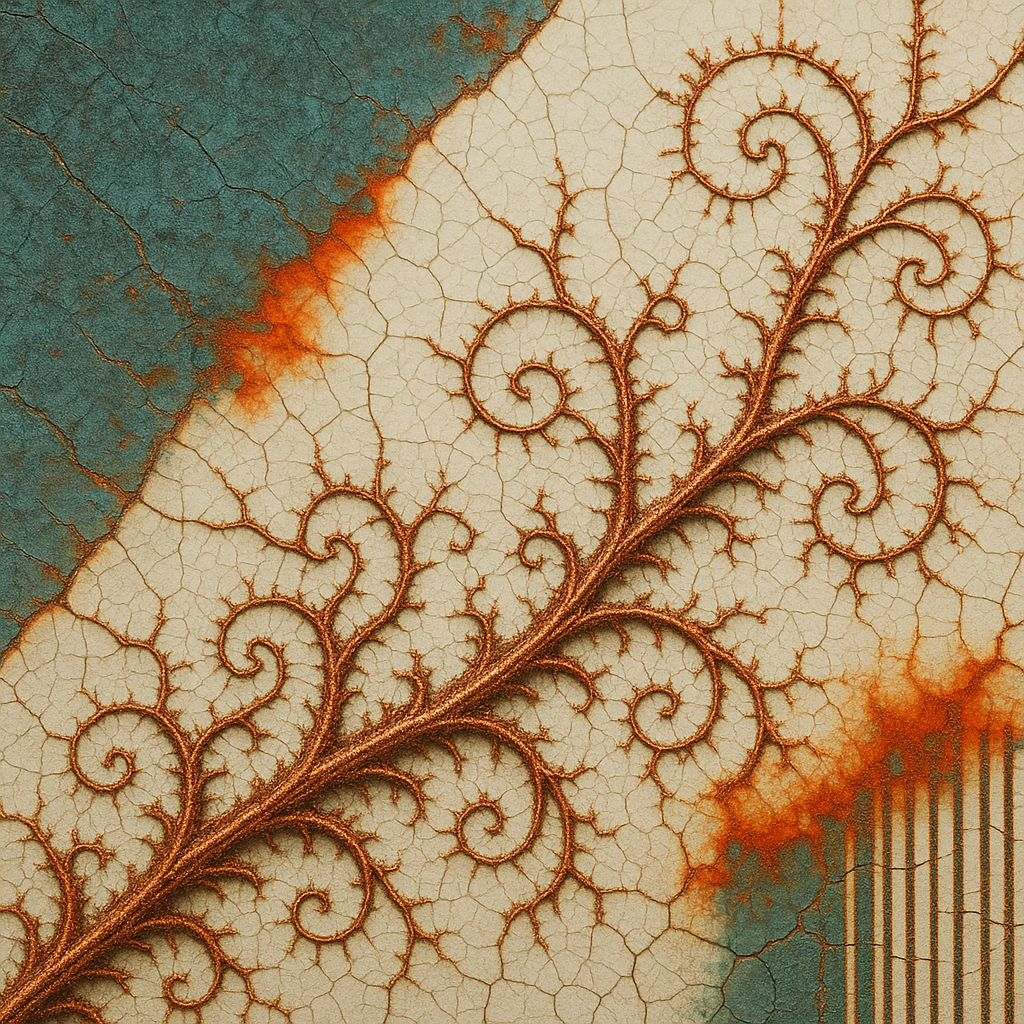
Exploded Diagram: Fractal Rust Vein
The artwork evokes a sense of organic complexity and ancient decay, blending natural fractal forms with the texture of weathered surfaces. There is a quiet tension between growth and erosion, with a subtle interplay of order and chaos.
Color Palette
oxidized teal
upper left and lower right background · 25%
aged parchment
main background area · 50%
rust orange
fractal vein, edges, and transition zones · 20%
deep brown
shadows and outlines of the fractal vein · 5%
Background
A cracked, aged surface resembling dried earth or old parchment, with a diagonal division between a teal-oxidized region and a pale, cream-colored area. The cracks form an intricate, irregular network, and there are rusty orange stains where the two color zones meet. In the lower right, a set of parallel vertical lines is faintly visible beneath the cracks and stains.
Visual Elements
fractal rust vein
dominant
anchor, symbol of organic growth and decay
A large, branching, spiral-form structure resembling a mathematical fractal or a dried plant vein. It is rendered in rusty orange and deep brown, with fine, hair-like offshoots and a fuzzy, textured edge. The main branch runs diagonally from lower left to upper right, with numerous curling sub-branches and spirals extending outward.
crack network
small
texture, symbol of age and impermanence
A fine, irregular web of cracks covering the entire background, resembling dried mud or aged glaze. The cracks are thin, dark brown, and vary in length and direction, providing a sense of age and fragility.
teal oxidized region
medium
accent, environmental context
A roughly triangular area in the upper left and lower right corners, colored in a mottled teal with subtle variations and powdery texture. The edges are irregular and blend into the parchment area with rusty orange transitions.
rust stains
medium
transition, visual warmth
Diffuse, irregular patches of rusty orange that appear where the teal and parchment regions meet, especially along the diagonal. The stains have a soft, feathered edge and vary in intensity.
vertical stripes
small
accent, hidden order
A set of thin, parallel, vertical lines faintly visible in the lower right corner beneath the crackle and stains. The stripes are subtle, regular, and slightly blurred, suggesting an underlying structure or artifact.
Connections
entity_1
→
entity_2
visual
The fractal vein overlays and interacts with the crack network, sometimes following or echoing the direction of the cracks.
entity_1
→
entity_4
color
The rust vein shares its color palette with the surrounding rust stains, creating a visual and conceptual link between growth and decay.
entity_3
→
entity_4
spatial
The teal oxidized region and rust stains blend at their borders, creating a gradual transition.
entity_5
→
background
visual
The vertical stripes are partially obscured by the crackle and stains, suggesting depth and layering.
Composition
Layout
Diagonal, with the main fractal vein running from lower left to upper right, dividing the image into two color fields.
Flow
The eye follows the fractal vein along its length, then explores the branching spirals and the contrasting background regions.
Balance
Asymmetrical, with dynamic tension between the organic vein and the geometric stripes
Negative Space
The pale parchment regions serve as negative space, highlighting the fractal vein and cracks.
Tension Points
Where the fractal vein crosses the rust-stained border, Dense spiral clusters along the vein
Techniques & Styles
fractal generation
The main vein is rendered with recursive, self-similar branching and spirals, mimicking natural fractal growth.
crackle glaze texture
The background is overlaid with a fine network of cracks, simulating aged ceramic or dried earth.
powdery blending
Rust stains and teal regions blend softly with feathered edges, creating organic transitions.
subtle underpainting
Faint vertical stripes are layered beneath the main surface textures, adding hidden structure.
Conceptual Layers
literal
A cracked, weathered surface with a branching vein or root structure.
symbolic
The fractal vein represents organic growth, resilience, and the passage of time, while the cracks and rust symbolize decay and impermanence.
emotional
A mood of quiet tension between life and entropy, with beauty found in both order and breakdown.