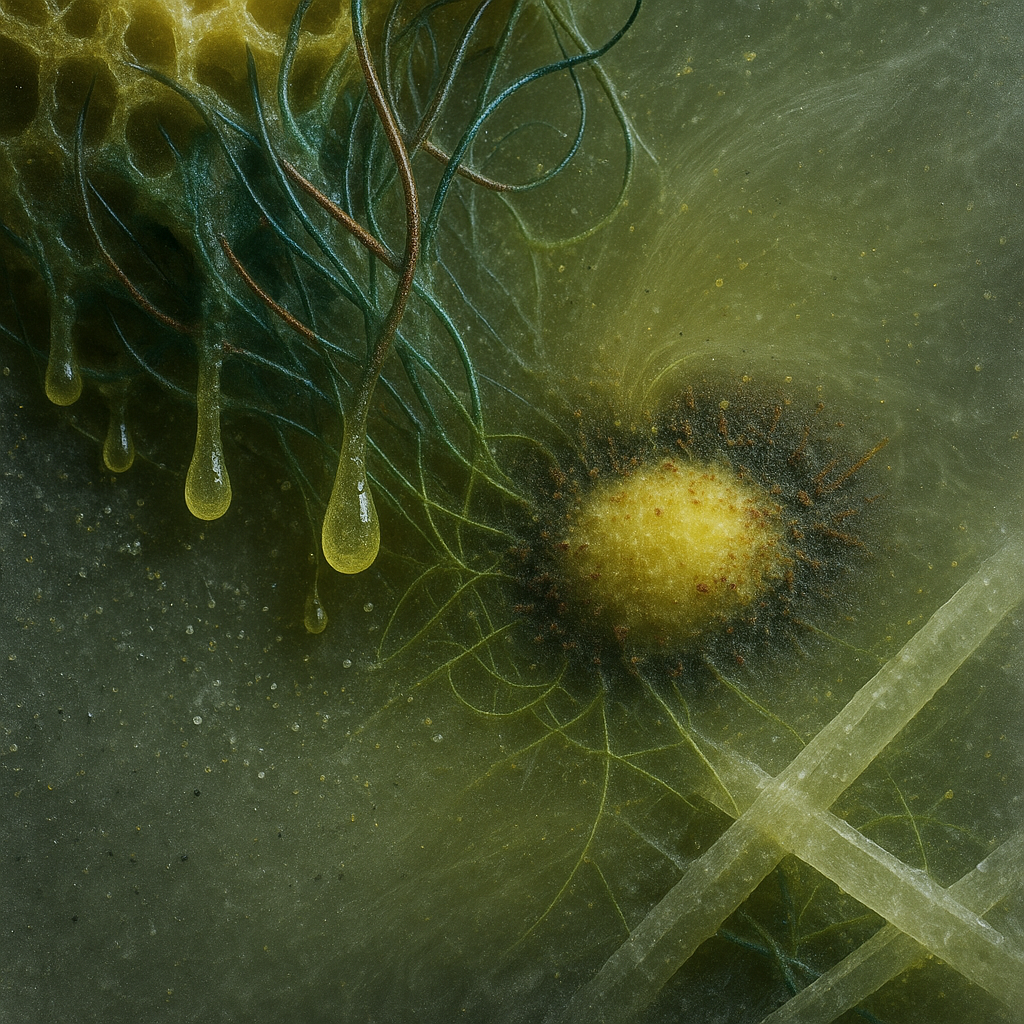
Exploded Diagram: Alien Cellular Microcosm
The artwork evokes a sense of organic mystery and subtle unease, as if peering into an alien or microscopic biological world. The muted green-yellow palette and softly glowing forms create an atmosphere that is both scientific and otherworldly, blending curiosity with a hint of the uncanny.
Color Palette
mossy olive green
background wash and primary field · 55%
pale yellow
highlight on droplets, filaments, and central sphere · 20%
muted teal
filamentary tendrils · 10%
rust brown
accent on filaments and central sphere's corona · 5%
translucent white
crossed translucent rods · 10%
Background
A softly textured, semi-translucent olive-green field with subtle mottling and particulate specks, suggesting depth and a liquid or gel-like medium. The background is uniform but contains faint swirling patterns and gradients, giving a sense of organic suspension.
Visual Elements
Honeycomb Matrix
dominant
anchor, organic origin point
A porous, honeycomb-like structure in the upper left, colored in yellow-green, with soft, rounded edges and a waxy, semi-translucent texture. The matrix appears to ooze or dissolve into the background, with several open cells and shadowed recesses.
Dripping Droplets
medium to small
accent, transition from structure to background
Four to five elongated, teardrop-shaped droplets hanging from the honeycomb matrix, rendered in translucent pale yellow. Each droplet has a glossy, wet appearance and reflects light along its surface.
Filamentous Tendrils
medium
transition, visual connector
A dense cluster of thin, curving tendrils in teal, green, and rust brown, emerging from the honeycomb and extending diagonally across the image. The tendrils are semi-translucent, with a fibrous, organic appearance, and some overlap or intertwine.
Central Spore Sphere
medium
focal point, symbol of biological core
A fuzzy, spherical form in the right-center, colored pale yellow with a darker, rust-brown corona of fine filaments radiating outward. The sphere is softly glowing, with a granular, pollen-like surface and a halo of wispy tendrils.
Translucent Crossed Rods
medium
structural accent, compositional balance
Two semi-transparent, pale yellow rods crossing each other in the lower right quadrant. The rods have a crystalline, frosted texture and cast soft shadows on the background. Their intersection forms a subtle X-shape.
Connections
entity_1
→
entity_2
visual
Droplets emerge directly from the honeycomb matrix, visually connecting the solid structure to the liquid forms.
entity_1
→
entity_3
spatial
Filamentous tendrils originate from the honeycomb, creating a sense of organic growth.
entity_3
→
entity_4
visual
Tendrils lead the eye toward the central spore sphere, linking the two entities.
entity_4
→
entity_5
spatial
The crossed rods intersect the field of tendrils and frame the central spore, providing compositional structure.
background
→
all entities
color
The olive-green background unifies the palette and provides atmospheric depth for all elements.
Composition
Layout
Diagonal, with major elements (honeycomb, tendrils, rods) forming intersecting axes.
Flow
The eye moves from the honeycomb in the upper left, down along the droplets and tendrils, to the central spore, and finally to the crossed rods.
Balance
Asymmetrical, with weight concentrated in the upper left and balanced by the rods and spore on the right.
Negative Space
Negative space is used in the lower left and upper right, allowing the forms to breathe and emphasizing the sense of suspension.
Tension Points
central spore sphere, intersection of crossed rods, dripping droplets
Techniques & Styles
Macro Organic Rendering
Highly detailed, close-up depiction of organic forms with emphasis on texture and translucency.
Atmospheric Depth
Use of gradients, soft focus, and particulate texture to create a sense of depth and immersion.
Translucency and Glow
Application of internal lighting and semi-transparent materials to create luminous, ethereal effects.
Conceptual Layers
literal
Depicts an abstracted microscopic or alien biological scene, with cellular and fluid forms.
symbolic
Suggests themes of growth, transformation, and the boundary between structure and fluidity.
emotional
Elicits curiosity, fascination, and a touch of unease through unfamiliar organic forms.