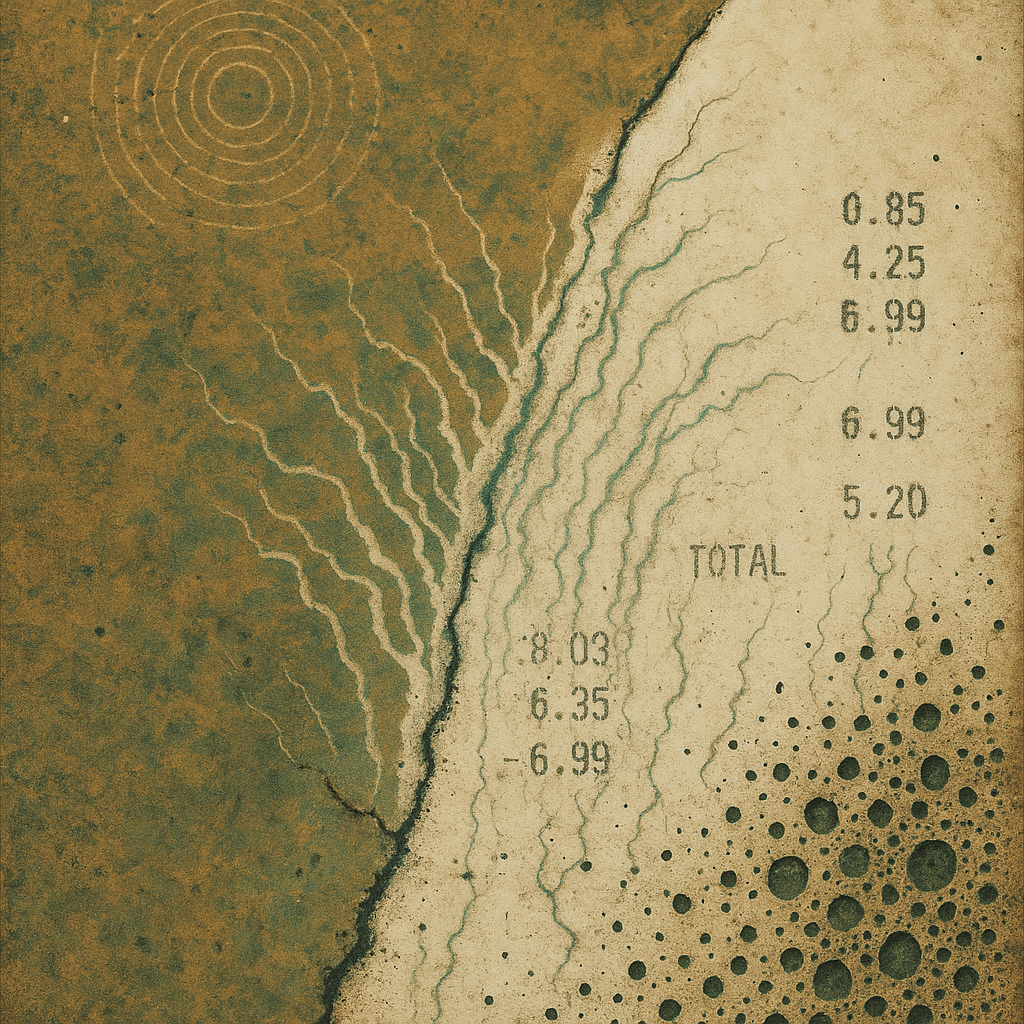
Exploded Diagram: Geological Calculation Map
The artwork evokes a sense of scientific curiosity and ancient mystery, blending mathematical notation with organic, geological forms. The muted, earthy palette and textured surfaces create an atmosphere reminiscent of old maps or archaeological diagrams, inviting contemplation of both order and chaos.
Color Palette
ochre brown
dominant background on left side · 45%
aged parchment
background on right side · 40%
deep moss green
shadows, circle interiors, and line accents · 8%
pale teal
contour lines and subtle highlights · 5%
graphite gray
text and numbers · 2%
Background
A split background with the left half covered in a mottled ochre brown texture resembling aged, weathered earth, and the right half in a lighter, parchment-like beige with subtle speckling. The division between the two is irregular, resembling a torn or eroded edge.
Visual Elements
Concentric Circles
medium
symbolic anchor, suggesting measurement or focus
A set of thin, evenly spaced concentric circles in pale teal, located in the upper left quadrant. The circles are semi-transparent and fade into the background, resembling a topographic or sonar map.
Radiating Contour Lines (Left)
large
organic transition, evokes natural processes
A series of irregular, branching lines in pale teal, radiating from the central dividing edge into the ochre brown field. The lines mimic water flow or geological fault lines.
Irregular Dividing Edge
dominant dividing line
boundary, transition, narrative divider
A jagged, dark, almost burnt-looking edge separating the brown and beige fields. The edge is uneven and textured, with some feathering and shadowing, enhancing the impression of erosion or burning.
Wavy Contour Lines (Right)
large
organic accent, evokes mapping or analysis
A set of undulating, parallel lines in pale teal, flowing from the dividing edge into the beige field. The lines are more regular and wave-like than those on the left, resembling elevation or water flow maps.
Mathematical Text and Numbers
medium
conceptual anchor, introduces analytical context
A vertical column of numbers and the word 'TOTAL', rendered in a faded, stamped graphite gray font. The numbers are aligned and spaced as if part of a calculation or receipt.
Clustered Circular Holes
medium to small
visual tension, symbol of decay or analysis
A dense cluster of circular holes or voids of varying sizes, concentrated in the lower right corner. The holes are dark, with soft edges, creating a sense of depth or erosion.
Connections
entity_1
→
background
visual
The concentric circles overlay the ochre brown background, blending via transparency and color harmony.
entity_2
→
entity_3
spatial
Radiating contour lines originate from the irregular dividing edge, emphasizing the transition.
entity_3
→
entity_4
spatial
The dividing edge serves as the source for both left and right contour lines, visually splitting the composition.
entity_5
→
entity_4
conceptual
The mathematical text aligns with the more regular, analytical contour lines, reinforcing the scientific theme.
entity_6
→
entity_5
visual
The cluster of holes appears beneath and around the text, as if the numbers are being eroded or analyzed.
Composition
Layout
asymmetrical, divided vertically with organic irregularity
Flow
Eye moves from upper left (concentric circles) along radiating lines to the central edge, then rightward to the text and downward to the cluster of holes.
Balance
asymmetrical, with visual weight on both left (lines/circles) and right (text/holes)
Negative Space
The beige right side provides negative space around the text and holes, enhancing their prominence.
Tension Points
irregular dividing edge, clustered holes, column of numbers
Techniques & Styles
Textured Wash
Simulated watercolor or ink wash creates the mottled, aged effect of the background.
Line Drawing Overlay
Fine, semi-transparent lines are layered over the background to form both concentric circles and contour patterns.
Stamp/Stencil Typography
Text and numbers appear stamped or stenciled, with slight fading and irregularity.
Void Clustering
Dark, soft-edged circles are clustered to simulate erosion or analysis holes.
Conceptual Layers
literal
Depicts a split landscape or map with geological and mathematical features.
symbolic
Represents the intersection of natural processes (erosion, flow) and human analysis (calculation, mapping).
emotional
Conveys a sense of curiosity, age, and the tension between order and entropy.
narrative
Suggests a story of discovery, measurement, and the passage of time.