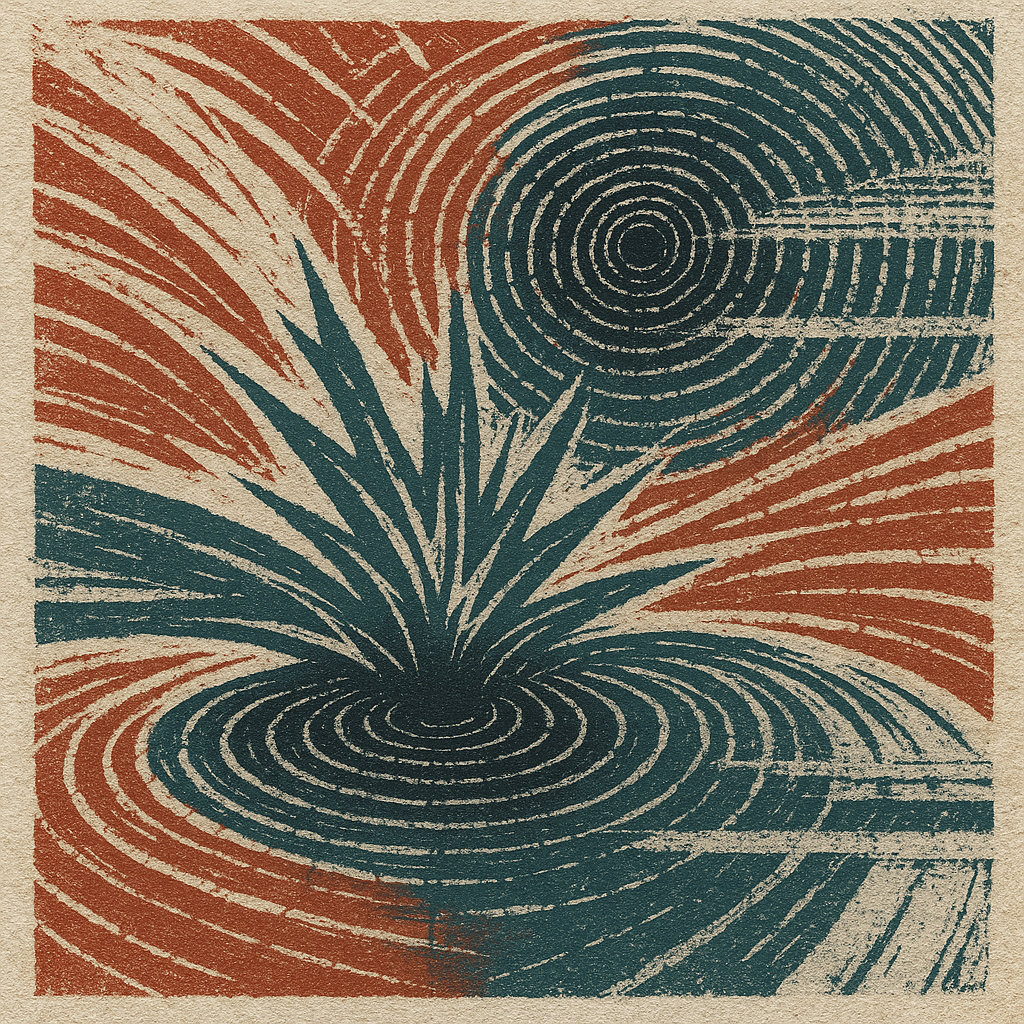
Exploded Diagram: Radiant Vortex Collision
The artwork evokes a sense of dynamic tension and energetic movement, as if two opposing forces are interacting or colliding. The bold, graphic lines and contrasting colors create a feeling of both chaos and order, reminiscent of natural phenomena like magnetic fields or explosions.
Color Palette
Deep Teal Blue
Primary color for lower vortex, radiating lines, and upper right concentric circles · 40%
Rust Orange
Secondary color for background rays and upper left quadrant · 40%
Aged Parchment
Background and negative space throughout the image · 20%
Background
A textured, aged parchment surface with visible grain and irregularities, providing a warm, neutral base. The background is mostly visible in the negative spaces between colored lines and shapes.
Visual Elements
Lower Vortex
Dominant
Anchor, focal point, source of energy
A series of concentric, irregular teal blue rings radiating outward from a central blackened point near the bottom center. The rings are slightly distressed, with rough edges and varying thickness, creating a sense of energy and motion.
Radiating Spikes
Medium to large
Accent, dynamic energy, transition
Sharp, jagged teal blue spikes emanating upward and outward from the center of the lower vortex, overlapping with the background and other elements. The spikes are irregular in length and direction, suggesting an explosive or eruptive force.
Upper Right Concentric Circles
Medium
Counterpoint, secondary focal point, symbol of order
A cluster of concentric teal blue circles centered in the upper right quadrant, with lines becoming more widely spaced as they radiate outward. The circles are distressed and partially interrupted by overlapping rays and background texture.
Rust Orange Radiating Rays
Large
Background structure, directional flow, tension
Broad, curved rays in rust orange radiate from the upper left and right sides toward the center, overlapping with teal elements and background. The rays are irregular, with distressed edges and varying thickness.
Connections
entity_1
→
entity_2
visual
The radiating spikes emerge directly from the lower vortex, visually linking the two as a single energetic event.
entity_1
→
entity_3
spatial
The lower vortex and upper right concentric circles are positioned as opposing poles, creating a sense of dynamic interaction or collision.
entity_2
→
entity_4
visual
The teal spikes intersect and overlap with the rust orange rays, creating areas of visual tension and layered depth.
entity_4
→
background
color
The rust orange rays contrast sharply with the parchment background, enhancing the sense of movement.
Composition
Layout
Diagonal and radial, with strong central and opposing poles
Flow
The eye is drawn from the lower vortex upward along the spikes, then across the radiating rays to the upper right circles, following the energetic lines.
Balance
Asymmetrical, but visually balanced by opposing forces and mirrored forms
Negative Space
Negative space is used to define the forms and enhance the sense of energy and movement; the parchment background acts as breathing room between bold elements.
Tension Points
Intersection of spikes and rays near center, Opposing vortex and concentric circles
Techniques & Styles
Linocut Print Simulation
Rough, distressed edges and visible print texture mimic traditional linocut or woodcut techniques, giving the image a tactile, handmade quality.
Radial and Concentric Linework
Use of concentric circles and radiating lines to create movement and focal points.
Conceptual Layers
literal
Abstract depiction of energetic forms, possibly referencing natural phenomena like explosions, magnetic fields, or waves.
symbolic
Represents opposing forces, dynamic tension, and the interaction between chaos and order.
emotional
Conveys a sense of energy, conflict, and movement, evoking excitement or agitation.