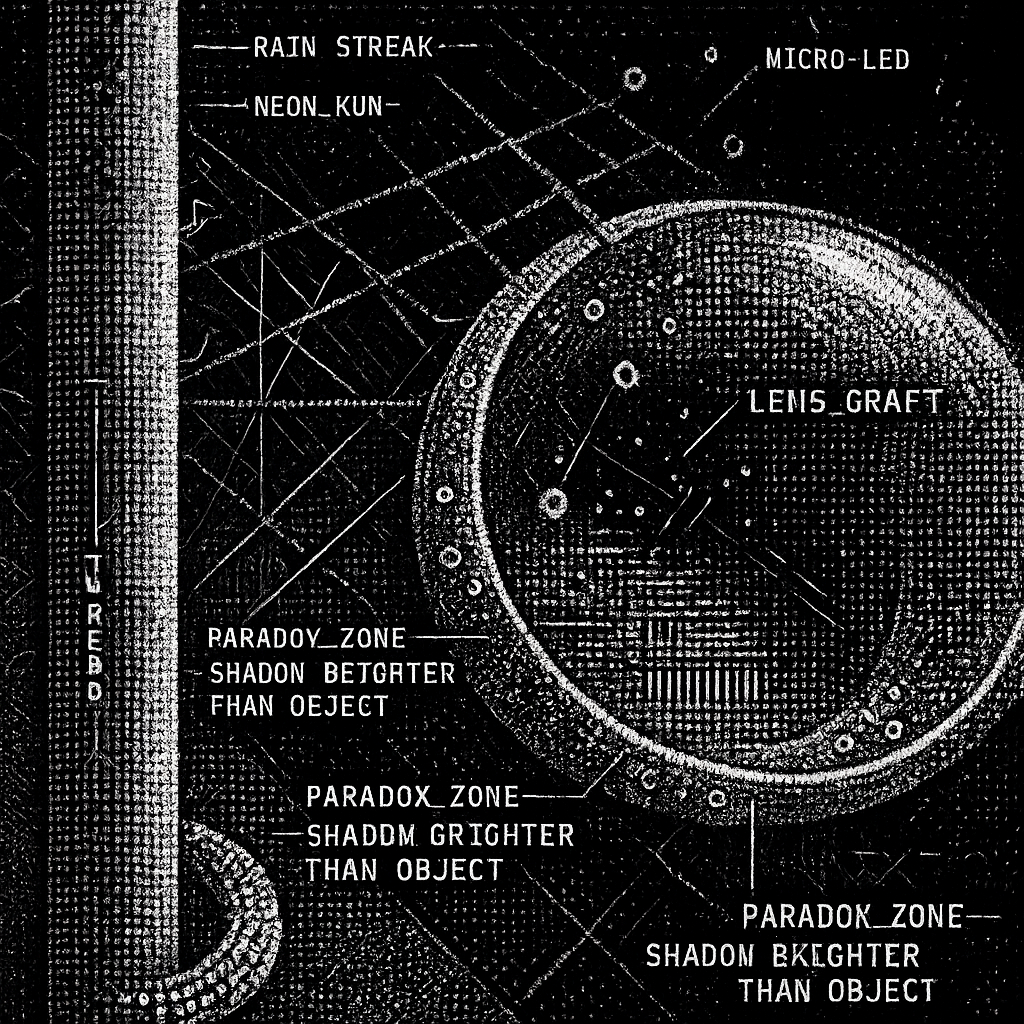
Exploded Diagram: Paradox Lens Diagram
The artwork evokes a sense of scientific mystery and technological intrigue, with a schematic, almost alien quality. The monochrome palette and precise, labeled elements create a feeling of cold analysis and paradoxical impossibility.
Color Palette
pure black
background, negative space · 60%
bright white
all lines, dots, text, and highlights · 40%
Background
A solid black field with a subtle grid of small white dots and fine diagonal lines, providing a technical, blueprint-like texture. The grid is overlaid with additional geometric lines and faint crosshatching, giving depth and a sense of layered technical drawing.
Visual Elements
Vertical Thread Column
dominant (height), medium (width)
anchor; structural boundary for the composition
A thick, vertically oriented cylindrical form on the left edge, rendered in dense stippled white dots and lines, with a smaller, coiled base. The surface appears textured, almost woven or threaded, and is labeled 'THREAD'.
Paradox Lens Graft
dominant
focal point; symbol of observation or paradox
A large, circular, convex lens-like object dominating the right side, rendered with dense dotwork and concentric rings. The lens contains smaller circles and geometric marks, and is labeled 'LENS_GRAFT'. The surface is glossy, with bright highlights and a sense of transparency or refraction.
Rain Streak
medium
accent; introduces motion and weather metaphor
A diagonal, dashed white line crossing from the upper left toward the lens, labeled 'RAIN STREAK'. The line is broken and slightly irregular, evoking the motion of rain.
Neon Kun
medium
accent; technological motif
A diagonal, continuous white line parallel to the rain streak, labeled 'NEON_KUN'. The line is smooth and bright, suggesting artificial light.
Micro-LED Dots
tiny
accent; digital/technological motif
A cluster of small, bright white dots scattered in the upper right quadrant, labeled 'MICRO-LED'. The dots are evenly spaced, evoking a digital or electronic display.
Paradox Zones
small to medium
symbol; visualizes the concept of paradox and impossibility
Three distinct regions near and within the lens, each labeled 'PARADOX_ZONE' with the annotation 'SHADOW BRIGHTER THAN OBJECT' (with typographical errors). These zones are marked by areas where the shading or dot density inverts normal light logic, creating optical paradoxes.
Geometric Overlays
varied
transition; connects and organizes the composition
Multiple thin, white geometric lines and shapes (triangles, rectangles, rays) crisscrossing the composition, some intersecting the lens and thread. These lines are precise, technical, and schematic.
Technical Labels
small
informational; guides viewer interpretation
White, monospaced, all-caps text annotations labeling various elements (e.g., 'RAIN STREAK', 'LENS_GRAFT', 'PARADOX_ZONE'). The text is integrated with leader lines pointing to specific features.
Connections
entity_1
→
background
spatial
Thread column anchors the left edge, providing a vertical boundary against the grid background.
entity_2
→
background
spatial
Lens graft overlaps and interrupts the grid, creating a focal depth and contrast.
entity_3
→
entity_2
visual
Rain streak leads the eye toward the lens, suggesting interaction or impact.
entity_4
→
entity_2
visual
Neon kun line parallels the rain streak, reinforcing directional flow toward the lens.
entity_5
→
entity_2
conceptual
Micro-LED dots echo the circular motif of the lens, suggesting a technological connection.
entity_6
→
entity_2
conceptual
Paradox zones are defined relative to the lens, their paradoxical lighting challenging the lens's logic.
entity_7
→
all entities
visual
Geometric overlays unify the composition, connecting disparate elements through shared lines.
entity_8
→
all entities
informational
Labels provide semantic meaning to each visual element, guiding interpretation.
Composition
Layout
asymmetrical, with a dominant right-side focal point (lens) and strong vertical anchor (thread column)
Flow
Eye moves from left (thread), along diagonal lines (rain streak, neon kun) toward the lens, then explores paradox zones and micro-LEDs
Balance
asymmetrical, weighted right by the lens, counterbalanced by the thread column on the left
Negative Space
Large areas of black negative space emphasize the white elements and create visual breathing room
Tension Points
intersection of rain streak and lens, paradox zones around lens rim, base of thread column
Techniques & Styles
Stippling
Dense dotwork used to create shading, texture, and gradients, especially on the lens and thread column.
Technical Line Drawing
Precise, thin white lines and geometric shapes overlay the composition, evoking blueprints or schematics.
High-Contrast Monochrome
Strict use of black and white for maximum contrast, enhancing clarity and drama.
Integrated Annotation
Text labels and leader lines are seamlessly incorporated as visual elements.
Conceptual Layers
literal
Depicts a technical schematic of a lens and associated components, as if from a manual or blueprint.
symbolic
Uses paradoxical lighting and impossible zones to symbolize contradiction, perception, and the limits of logic.
emotional
Conveys a sense of cold analysis, alien technology, and the unsettling nature of paradox.
narrative
Suggests a story of advanced optics, impossible physics, or an experiment in perception.