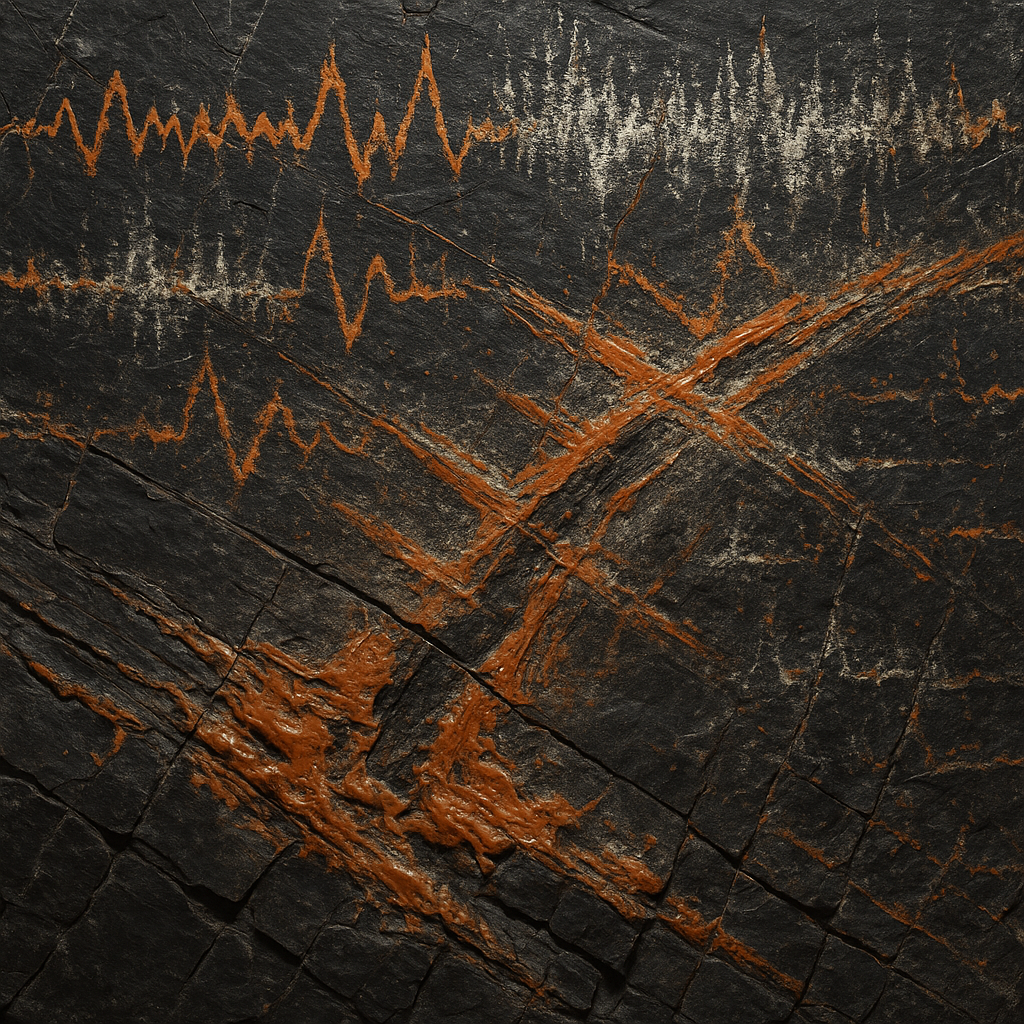
Exploded Diagram: Petroglyph Waveforms
The artwork evokes a sense of ancient mystery and scientific intrigue, blending the primal texture of rock with the analytical abstraction of waveform patterns. It feels both grounded and enigmatic, suggesting a hidden narrative or message inscribed in stone.
Color Palette
Charred Basalt Black
dominant background rock surface · 70%
Oxidized Iron Orange
waveform and fissure markings · 20%
Chalky Limestone White
secondary waveform markings and highlights · 8%
Ashen Gray
subtle stone highlights and midtones · 2%
Background
A rough, cracked stone slab with a matte, uneven surface. The rock is dark, with visible fissures, striations, and subtle color variations, giving it a weathered, geological appearance. The cracks form irregular, angular patterns across the surface.
Visual Elements
Orange Waveform Petroglyph
Dominant
Anchor and focal symbol, suggesting communication or signal
A jagged, zigzagging line rendered in rusty orange, resembling an audio waveform or seismograph trace. The line is uneven in thickness, with sharper peaks and valleys, and appears to be etched or painted onto the stone. It runs horizontally across the upper third of the image and diagonally across the lower half, intersecting with other lines.
White Waveform Petroglyph
Medium
Accent and contrast, reinforcing the signal motif
A thinner, chalky white waveform line, more granular and less continuous than the orange line. It runs parallel and just above the orange waveform in the upper third, with a more static, noise-like pattern. The line appears to be dusted or scratched onto the surface, with some areas more faded than others.
Intersecting Orange Fissures
Dominant
Structural anchor, suggesting geological time or disruption
Two broad, rusty orange fissures or mineral veins cross diagonally in the lower right quadrant, forming an 'X' shape. The fissures are wider and more textured than the waveform lines, with rough, irregular edges and a sense of depth, as if the rock has split and been filled with oxidized material.
Connections
entity_1
→
entity_2
visual
The orange and white waveforms are parallel and visually echo each other, creating a layered signal motif.
entity_1
→
entity_3
spatial
The orange waveform and fissures intersect and overlap, blending the symbolic (signal) with the geological (fissure).
entity_3
→
background
material
The fissures appear to be part of the stone itself, integrating with the background texture and cracks.
entity_2
→
background
color
The white waveform stands out against the dark stone, creating a high-contrast focal area.
Composition
Layout
Diagonal and horizontal, with intersecting lines creating a dynamic, crisscross structure
Flow
The eye follows the orange waveform horizontally, then is drawn diagonally by the fissures, looping back to the white waveform above
Balance
Asymmetrical, with visual weight concentrated in the lower right and upper left
Negative Space
Dark stone areas between lines and fissures provide breathing room and emphasize the markings
Tension Points
Intersection of orange fissures, Area where waveforms overlap, Upper left and lower right corners where lines exit the frame
Techniques & Styles
Petroglyph Simulation
Waveform and fissure lines are rendered to mimic ancient rock carvings or mineral stains, with rough, uneven edges and powdery textures.
Photorealistic Stone Texture
Background is highly detailed, with realistic cracks, mineral deposits, and surface variation.
Conceptual Layers
literal
Depicts a cracked stone surface with colored markings resembling ancient petroglyphs.
symbolic
The waveform patterns evoke ideas of communication, data, or seismic activity, suggesting a message or record inscribed in stone.
emotional
Conveys a sense of timelessness, mystery, and the intersection of natural and human-made marks.