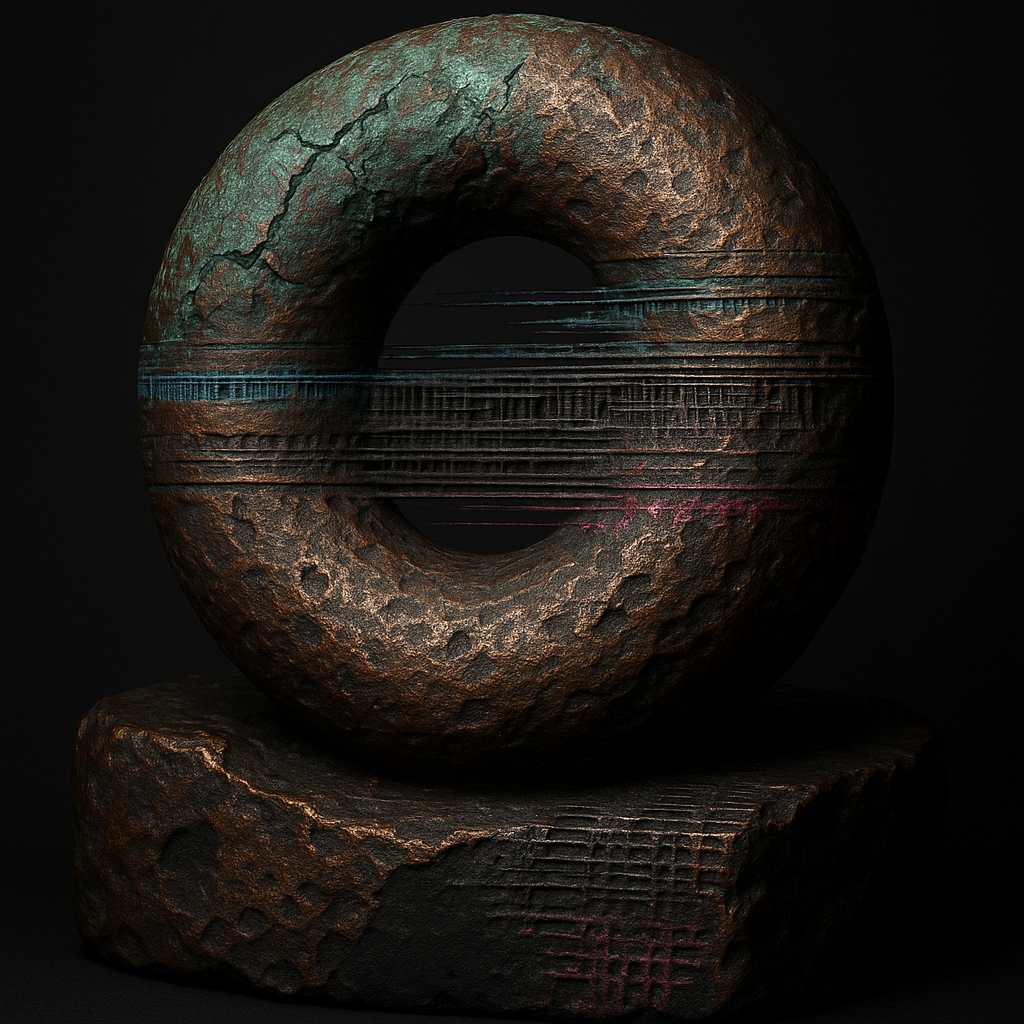
Exploded Diagram: Eroded Stone Torus Monument
The artwork exudes a sense of ancient mystery and solemnity, with its weathered textures and dark, subdued palette. The interplay of rough, stony surfaces and subtle colored striations suggests the passage of time and hidden histories, evoking both monumentality and decay.
Color Palette
oxidized copper green
upper left of torus, accenting weathered areas · 10%
deep bronze brown
primary color of torus and base, dominant overall · 60%
charcoal black
background and shadowed crevices, negative space · 20%
muted magenta
thin horizontal striations, lower right of torus and base · 3%
teal blue
horizontal striations, upper left of torus · 5%
weathered ochre
highlights on stone texture · 2%
Background
A seamless, deep charcoal black backdrop with no discernible texture or gradient, providing a void-like negative space that isolates the sculptural forms.
Visual Elements
eroded stone torus
dominant
anchor, central symbol of endurance and passage of time
A large, thick torus with a heavily pitted, weathered stone surface. The torus is marked by cracks, dimples, and a patina of oxidized copper green on its upper left. Horizontal striations in teal blue and muted magenta cut across its midsection, appearing as incised or eroded lines. The lighting creates subtle highlights and deep shadows, emphasizing the roughness and volume.
textured stone plinth
medium
foundation, support, visual grounding
A rectangular, blocky base with the same rough, pitted stone texture as the torus. The plinth is marked by subtle horizontal and grid-like incised lines in teal and magenta, echoing the torus's striations. Its edges are irregular and worn, suggesting age and erosion.
horizontal colored striations
small but visually significant
accent, transition, symbolic of time or data
Thin, sharp, incised lines running horizontally across both the torus and the plinth. These lines are rendered in teal blue and muted magenta, creating a sense of artificial intervention or coded language. Some lines are continuous, while others are broken or layered, adding a digital or signal-like quality.
Connections
entity_1
→
entity_2
spatial
The torus rests directly atop the plinth, visually and physically supported by it.
entity_3
→
entity_1
visual
The colored striations are incised into the torus, breaking up its surface and drawing the eye horizontally.
entity_3
→
entity_2
visual
The striations continue onto the plinth, creating a visual link and rhythm between the two forms.
entity_1
→
background
contrast
The torus's textured, illuminated surface stands out starkly against the infinite black background.
Composition
Layout
central, monolithic arrangement with the torus as the focal point atop a rectangular base
Flow
The eye is drawn first to the torus's central void, then follows the horizontal striations across the form and down to the plinth.
Balance
symmetrical, with the torus and plinth centered and aligned vertically
Negative Space
The black background creates ample negative space around the forms, emphasizing their isolation and monumentality.
Tension Points
intersection of colored striations with torus surface, central void of the torus, highlighted upper left edge of the torus
Techniques & Styles
simulated erosion
The stone surfaces are rendered with deep pits, cracks, and irregularities, mimicking natural weathering.
incised color striation
Sharp, colored lines are etched into the stone, appearing as artificial interventions or coded markings.
patina simulation
Areas of the torus are overlaid with a greenish patina, suggesting oxidation of copper or bronze.
dramatic single-source lighting
Soft, directional light from the upper left creates strong highlights and deep shadows, emphasizing form and texture.
Conceptual Layers
literal
Depicts a weathered stone torus resting on a stone plinth, marked by colored incisions.
symbolic
The torus and plinth evoke ancient monuments or artifacts, suggesting endurance, cycles, and the passage of time.
emotional
Conveys a sense of solemnity, isolation, and the weight of history or memory.
narrative
Hints at a forgotten civilization or coded language, with the striations acting as remnants of communication or ritual.