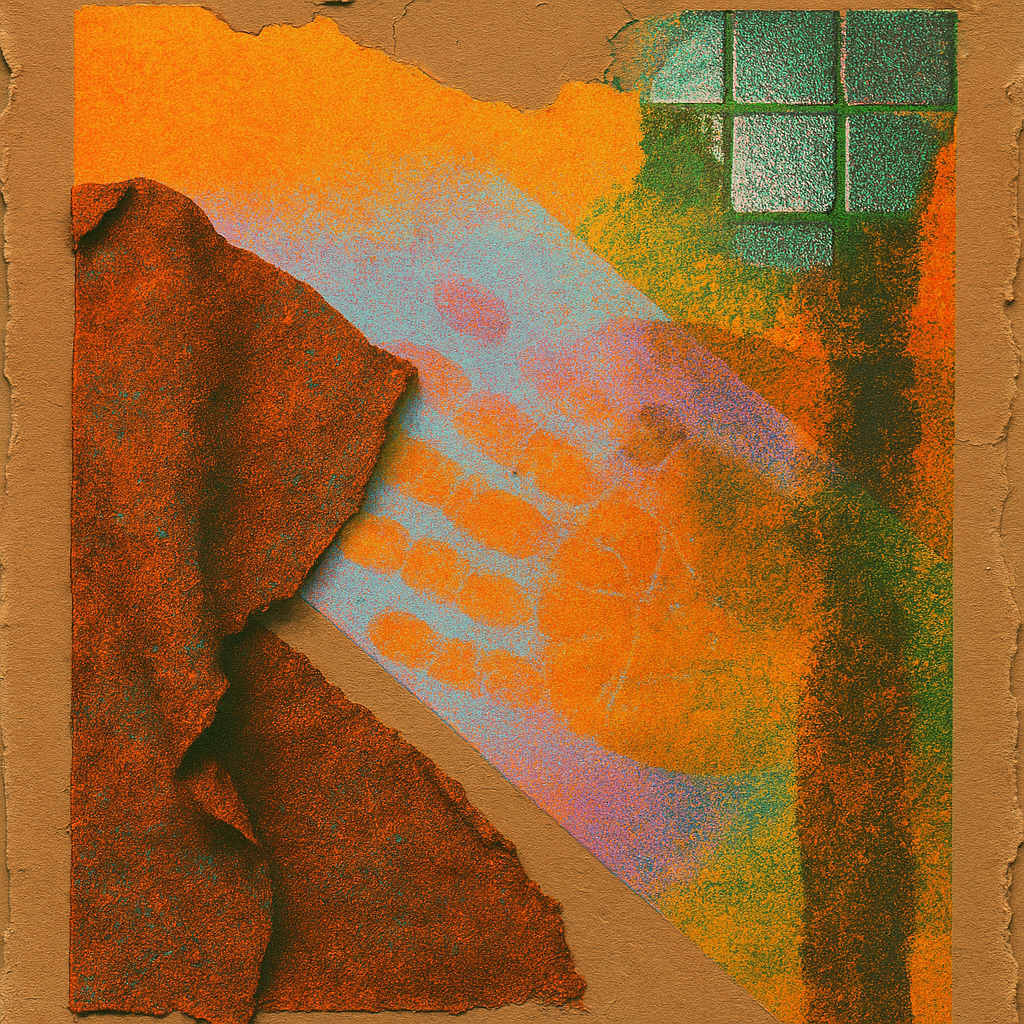
Exploded Diagram: Handprint Through Torn Paper
The artwork evokes a sense of tactile nostalgia and layered memory, with a warm, earthy palette and a mysterious, almost archaeological atmosphere. The juxtaposition of organic textures and geometric forms creates a tension between the natural and the constructed.
Color Palette
burnt sienna
dominant torn paper and border · 40%
vivid orange
background wash and handprint highlights · 25%
soft lavender
handprint shadow and midground gradient · 10%
moss green
upper right corner and window grid · 10%
metallic teal
window grid reflection · 5%
muted yellow
background blending and handprint · 5%
deep brown
shadow and edge details · 5%
Background
A textured, ochre-brown paper surface with rough, irregular torn edges, forming a border around the entire composition. The central area is filled with a gradient wash of orange and yellow, blending into green and lavender hues toward the right.
Visual Elements
Torn Rust-Colored Paper
dominant
anchor, tactile barrier
A large, irregularly torn piece of textured paper in a deep rust color, occupying the left and lower left quadrant. The edges are jagged and the surface is rough and fibrous, casting soft shadows onto the background.
Translucent Handprint
medium to large
symbol, memory imprint
A large, semi-transparent handprint rendered in orange, lavender, and yellow hues, with visible finger segments and palm lines. The handprint appears to be pressed onto or beneath the surface, partially obscured by the torn paper.
Green Window Grid
small
accent, conceptual window
A small, four-pane window grid in metallic teal and moss green, located in the upper right corner. The panes have a subtle reflective sheen, with highlights suggesting glass or glazed ceramic.
Connections
entity_1
→
entity_2
spatial
The torn paper partially overlays the handprint, creating a sense of depth and concealment.
entity_2
→
background
color
The handprint's colors blend into the background gradient, merging edges and creating a soft transition.
entity_3
→
background
visual
The window grid sits atop the background, its sharp geometry contrasting with the organic gradients.
entity_3
→
entity_2
conceptual
The window grid and handprint together evoke themes of presence, separation, and observation.
Composition
Layout
Diagonal, with a strong left-to-right downward movement and a secondary vertical axis from the window grid.
Flow
The eye enters at the torn paper, follows the diagonal handprint, and is drawn up to the window grid.
Balance
Asymmetrical, with visual weight concentrated on the left and upper right.
Negative Space
Used in the lower right and upper left, allowing the handprint and window to stand out.
Tension Points
intersection of torn paper and handprint, window grid in upper right
Techniques & Styles
Textured Paper Simulation
Emulates the look of rough, fibrous paper with torn edges and layered pigment.
Pastel Gradient Blending
Soft, powdery transitions between colors, creating a dreamlike, diffuse effect.
Translucent Overlay
Semi-transparent handprint layered over the background, allowing colors to mix.
Metallic Highlighting
Glossy, reflective accents on the window grid, giving a sense of glass or metal.
Conceptual Layers
literal
Depicts torn paper, a handprint, and a window grid.
symbolic
The handprint suggests memory or presence, the window grid implies separation or observation, and the torn paper evokes concealment or discovery.
emotional
Conveys nostalgia, longing, and the tactile sensation of touch and texture.
narrative
Hints at a story of someone reaching out, a barrier between inside and outside, or a preserved moment in time.