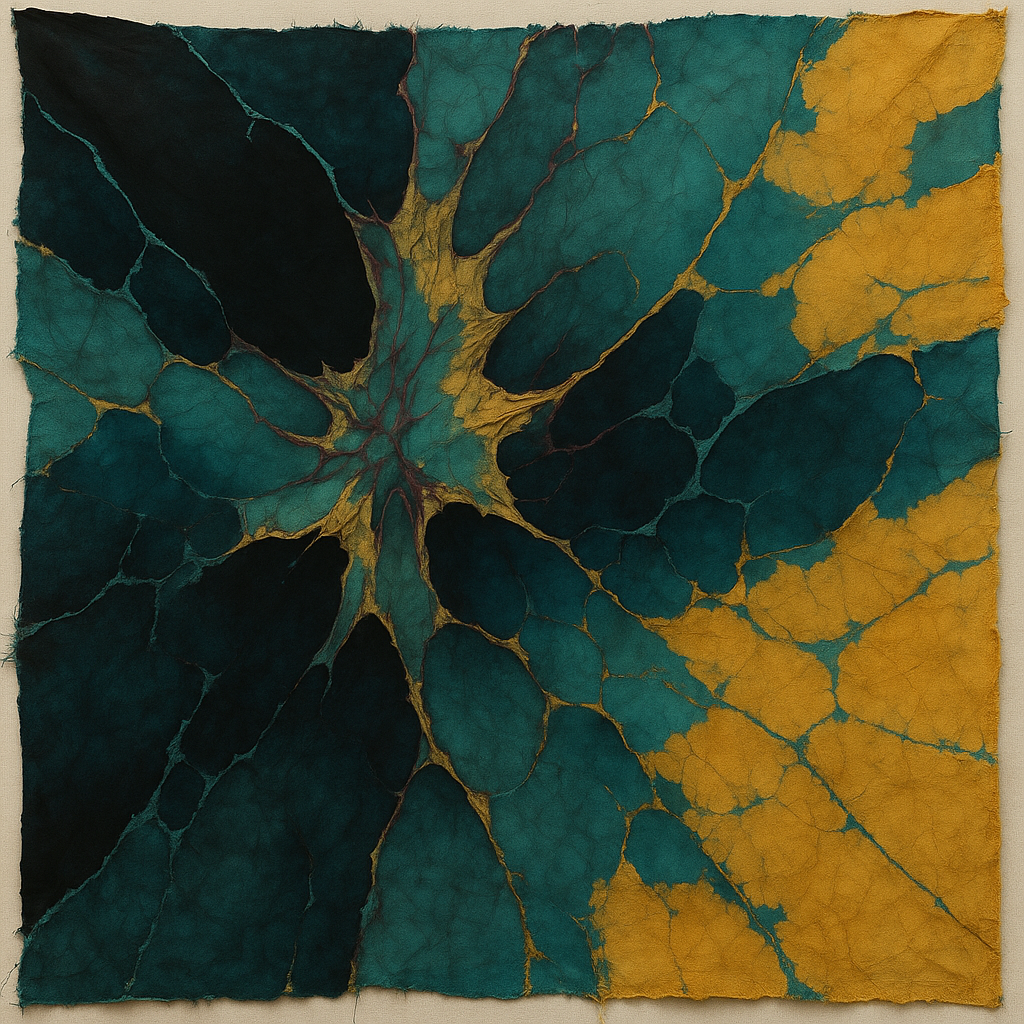
Exploded Diagram: Fractured Vein Textile
The artwork evokes a sense of organic tension and dynamic energy, as if capturing a moment of rupture or growth. The interplay of deep teal, golden yellow, and black creates a dramatic, almost geological or biological atmosphere, suggesting both fragility and resilience.
Color Palette
deep teal
dominant color in central and left regions · 55%
golden ochre
accent color in right and lower right regions, vein highlights · 25%
charcoal black
shadowed left regions, deep cracks · 15%
muted burgundy
fine vein outlines and central fissures · 3%
pale parchment
background border around textile · 2%
Background
A flat, pale parchment-colored surface that frames the textile square, with subtle paper texture and slightly irregular edges where the textile meets the background.
Visual Elements
Fractured textile square
Dominant
Anchor and primary subject, representing organic fracture, growth, or division
A roughly square piece of textile or paper with irregular, frayed edges. The surface is dominated by a network of branching, vein-like cracks that radiate from a central point, dividing the surface into irregular polygonal cells. The left and central regions are deep teal, the right regions are golden ochre, and the cracks are outlined in muted burgundy and black. The textile appears thin, fibrous, and slightly translucent, with visible layering and subtle color gradients within each cell.
Radiating vein network
Medium to fine (relative to overall textile)
Transition and structural element, visually dividing and connecting colored regions
A web of branching, irregular lines that radiate outward from a central area, forming the boundaries between colored cells. The veins are highlighted with muted burgundy and black, with some yellow edges, and have a slightly raised, threadlike appearance, as if stitched or painted onto the textile.
Colored cell clusters
Medium to small
Field and accent, creating visual rhythm and color contrast
Irregular, organic polygonal shapes formed by the vein network. Each cell is filled with a gradient of either deep teal or golden ochre, with subtle internal marbling and fibrous texture. The cells vary in size, with larger ones toward the edges and smaller, more concentrated ones near the center.
Connections
entity_1
→
background
visual
The textile square sits atop the pale background, its frayed edges creating a tactile boundary.
entity_2
→
entity_3
spatial
The vein network defines and separates the colored cell clusters, creating a sense of organic division.
entity_2
→
entity_1
material
The veins appear integrated into the textile, as if stitched or painted onto its surface.
entity_3
→
entity_1
material
The colored cells are integral to the textile, their gradients and marbling following the fabric's grain.
Composition
Layout
Radial, with a central point of origin and outward branching
Flow
The eye is drawn to the central burst and follows the radiating veins outward, tracing the division of color fields
Balance
Asymmetrical, with dynamic tension between left (teal/black) and right (ochre) regions
Negative Space
Minimal; the textile fills the frame, with only a thin border of background visible
Tension Points
Central burst where veins converge, Sharp color transitions at cell boundaries
Techniques & Styles
Batik crackle dyeing
The branching, vein-like cracks and marbled color gradients resemble effects produced by batik or tie-dye techniques, where wax resist and dye create organic fracture patterns.
Textile collage
The visible fibers and frayed edges suggest the use of handmade textile or paper, possibly layered or collaged.
Gradient wash
Soft, blended color transitions within each cell, achieved through wet-on-wet dye or paint application.
Conceptual Layers
literal
A dyed or painted textile square with organic fracture patterns.
symbolic
Represents natural processes of growth, division, or rupture—echoing veins in leaves, cracks in earth, or cellular structures.
emotional
Conveys tension, resilience, and the beauty of imperfection through its fractured, organic forms.