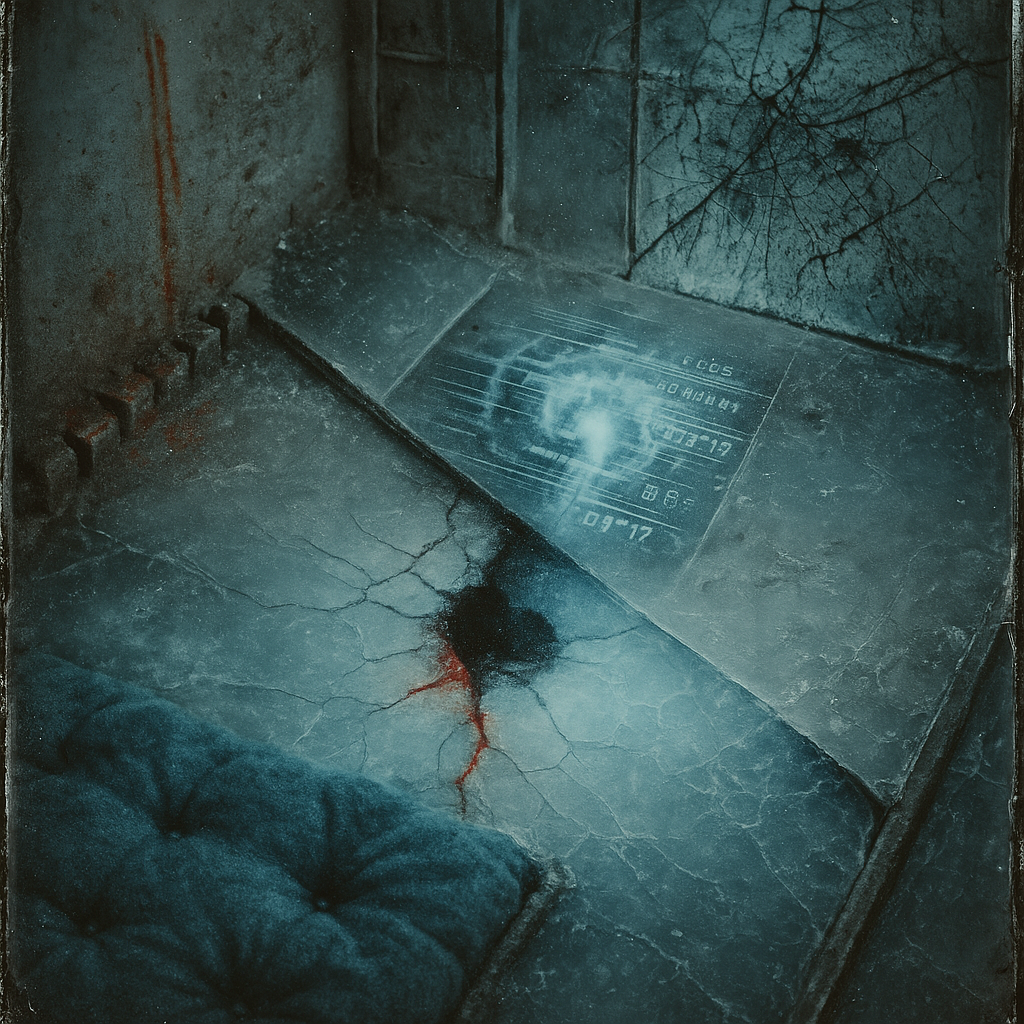
Exploded Diagram: Futuristic Prison Cell
The atmosphere is cold, oppressive, and bleak, evoking a sense of isolation and despair. The harsh lighting, cracked surfaces, and digital projection suggest a dystopian or cyberpunk setting, with undertones of violence or trauma.
Color Palette
icy teal
dominant color for walls, floor, and general lighting · 60%
muted steel gray
secondary color for concrete surfaces and shadows · 25%
glowing cyan
used in the digital projection on the floor · 5%
deep black
used for cracks, blood pool, and shadowed areas · 5%
dried blood red
used for blood stains and streaks · 5%
Background
A cold, concrete cell with cracked and stained surfaces. The walls are rough, with visible grime, cracks, and a large spiderweb-like fracture in the upper right. The lighting is dim and bluish, enhancing the sense of chill and neglect.
Visual Elements
Tufted Mattress
medium
anchor; suggests human presence or habitation
A small, rectangular, tufted mattress or cushion in the lower left corner. The surface is rough, with visible fabric texture and deep button tufts. The color is a desaturated teal, blending into the cold palette.
Cracked Floor with Blood Stain
dominant
focal point; suggests violence or trauma
A cracked concrete floor with a central blackened impact mark, radiating cracks, and a streak of dried blood extending from the center. The cracks are sharp and jagged, and the blood is a dark, dried red.
Digital Projection Panel
medium
accent; introduces a technological element and narrative ambiguity
A semi-transparent, glowing cyan digital interface projected onto the floor. The panel displays abstract data, symbols, and a central glowing orb or fingerprint, with lines and numbers suggesting a futuristic control or monitoring system.
Wall Blood Streaks
small
accent; reinforces sense of violence and neglect
Vertical streaks of dried blood on the left wall, running down from an unseen source. The blood is dark and partially absorbed into the rough concrete.
Wall Cracks and Fissures
medium
transition; enhances mood and visual interest
A network of black, spiderweb-like cracks spreading across the upper right wall. The cracks are thin but prominent, suggesting structural decay.
Connections
entity_2
→
entity_4
conceptual
Both elements use blood to suggest violence and trauma, linking the floor and wall visually and narratively.
entity_2
→
entity_3
spatial
The cracked floor and digital projection overlap spatially, with the projection partially illuminating the cracks and stain.
entity_1
→
entity_2
spatial
The mattress is positioned adjacent to the cracked floor, suggesting proximity to the site of violence.
entity_5
→
background
visual
The wall cracks integrate with the overall texture and decay of the background, enhancing the sense of neglect.
Composition
Layout
Diagonal, with the floor and wall meeting at a sharp angle; key elements distributed along this axis.
Flow
The eye moves from the mattress (bottom left) to the blood stain (center), then up to the digital projection and wall cracks (upper right).
Balance
Asymmetrical; visual weight is concentrated in the lower left and upper right.
Negative Space
Large areas of bare, cracked concrete create negative space, emphasizing isolation and emptiness.
Tension Points
central blood stain and cracks, digital projection panel, wall blood streaks
Techniques & Styles
Textured Digital Painting
Rough, painterly textures simulate concrete, grime, and fabric; digital overlays add grime and cracks.
Holographic Overlay
Semi-transparent, glowing digital interface projected onto a physical surface.
Atmospheric Lighting
Cool, bluish lighting with harsh highlights and deep shadows to enhance mood.
Conceptual Layers
literal
A prison or holding cell with a mattress, cracked floor, blood stains, and a digital interface.
symbolic
Themes of isolation, violence, technological surveillance, and decay.
emotional
Feelings of despair, coldness, and unease.
narrative
Hints at a violent event and the presence of advanced technology in a neglected, oppressive environment.