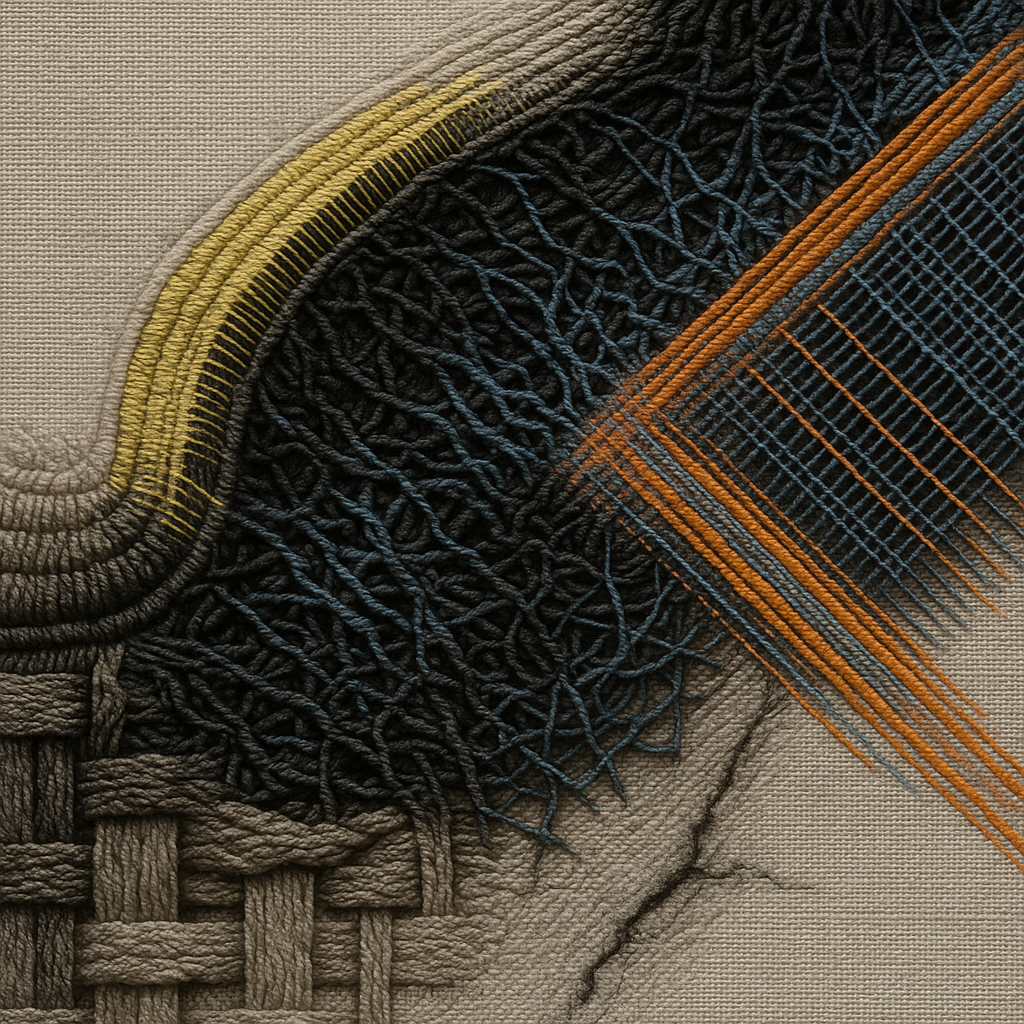
Exploded Diagram: Textile Interlace Abstraction
The artwork evokes a sense of tactile complexity and organic structure, blending order and chaos through textile-like forms. The interplay of woven, tangled, and linear elements creates a dynamic tension, while the earthy palette grounds the composition in a natural, crafted feel.
Color Palette
warm taupe
background fabric and woven elements · 40%
deep charcoal
tangled thread mass and shading · 25%
muted ochre
curved stitched highlight · 10%
burnt orange
diagonal linear threads · 10%
steel blue
tangled and linear threads · 10%
light beige
highlighted background and thread accents · 5%
Background
A coarse, woven fabric texture in warm taupe, with visible horizontal and vertical weave patterns, slightly uneven and organic. Subtle shading and faint cracks in the lower right add depth and realism.
Visual Elements
Curved Yellow-Brown Stitch Band
Medium
Transition and boundary marker
A thick, curved band of tightly packed stitches, transitioning from muted ochre to brown, following a smooth arc from upper left to center. The stitches are raised, with a tactile, embroidered appearance.
Tangled Thread Mass
Dominant
Organic chaos and visual anchor
A dense, chaotic cluster of interwoven threads in deep charcoal and steel blue, forming an irregular organic patch. The threads overlap and twist, creating a sense of depth and complexity.
Diagonal Linear Thread Array
Medium
Orderly accent and directional flow
A precise array of parallel threads in burnt orange and steel blue, running diagonally from upper right to lower left. The threads are evenly spaced, with some overlapping and fading at the edges, creating a sense of movement.
Woven Textile Grid
Small
Structural anchor and tactile base
A rectangular section of interlaced threads in taupe and brown, forming a classic over-under weave pattern. The threads are thick, with visible texture and slight irregularities.
Subtle Cracks
Tiny
Aging accent and textural contrast
Thin, organic black cracks etched into the background fabric, branching irregularly and fading at the ends. They add a sense of age and fragility.
Connections
entity_1
→
entity_2
visual
The curved stitch band forms a boundary and transition into the tangled thread mass, guiding the eye from order to chaos.
entity_2
→
entity_3
spatial
The tangled thread mass underlies and partially intermingles with the diagonal thread array, creating depth and layering.
entity_4
→
background
material
The woven textile grid emerges directly from the fabric background, blending seamlessly at the edges.
entity_5
→
background
conceptual
The cracks disrupt the otherwise intact fabric, introducing a sense of imperfection and age.
Composition
Layout
Diagonal and curvilinear, with strong directional elements crossing the frame
Flow
The eye follows the curved stitch band into the tangled mass, then along the diagonal threads toward the lower left, finally resting on the woven grid and cracks
Balance
Asymmetrical, with heavier visual weight on the left and dynamic tension from diagonal lines
Negative Space
Background fabric areas provide breathing room, especially in the lower right and upper left
Tension Points
Intersection of tangled mass and diagonal threads, Curved band meeting the tangled area
Techniques & Styles
Textile Simulation
Digital rendering of threads, stitches, and fabric textures to mimic real embroidery and weaving
Layered Depth
Overlapping and interweaving elements create a sense of spatial layering and tactile depth
Organic Linework
Irregular, hand-drawn lines for cracks and tangled threads, adding organic imperfection
Conceptual Layers
literal
Depicts textile techniques—embroidery, weaving, and fabric textures—in a stylized, abstract manner.
symbolic
Contrasts order (weaving, straight threads) with chaos (tangled mass), and newness (intact stitches) with age (cracks).
emotional
Evokes tactile curiosity and a sense of crafted complexity, with underlying tension between structure and disorder.