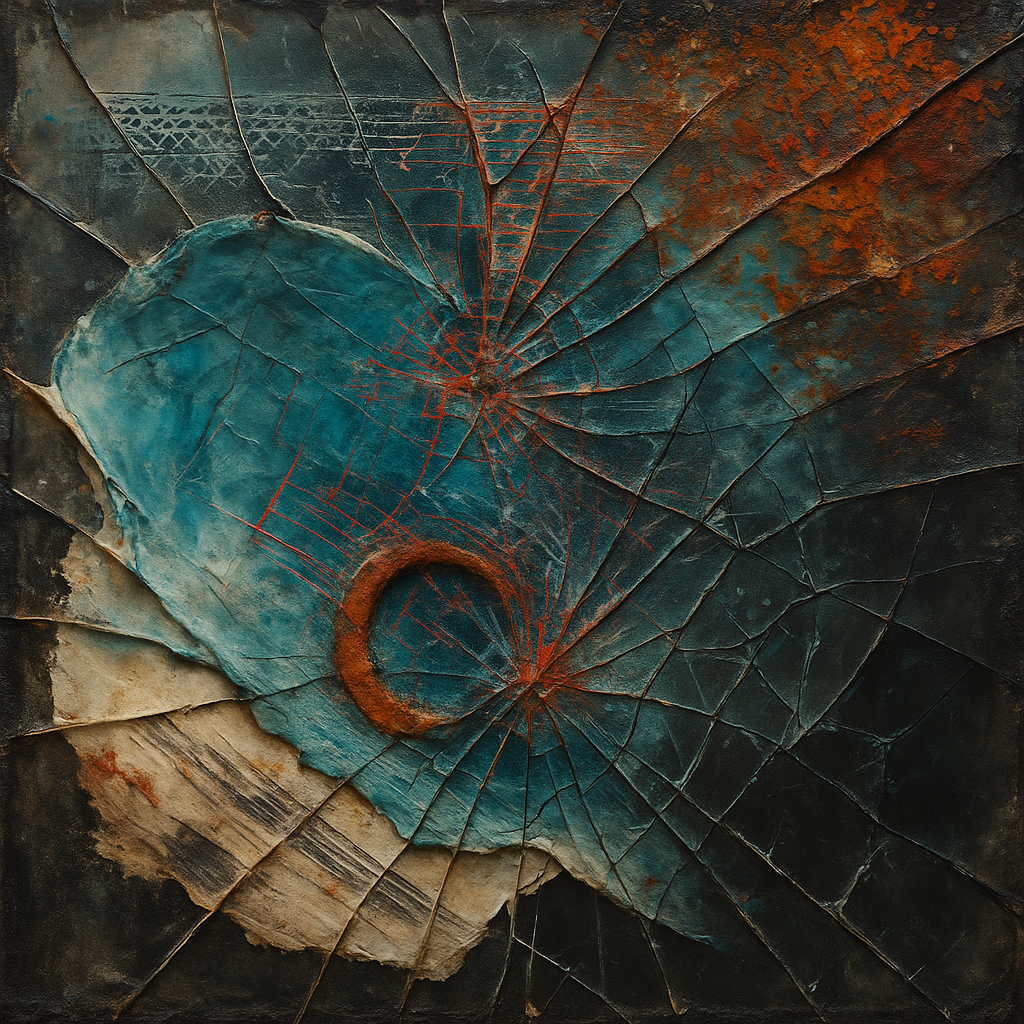
Exploded Diagram: Fractured Rusted Veil
The artwork evokes a sense of decay and tension, with a haunting beauty emerging from the interplay of fractured surfaces and oxidized textures. The mood is introspective and mysterious, suggesting both destruction and transformation.
Color Palette
oxidized teal
dominant color in the central fractured area · 40%
burnt rust
accents and corrosion across cracks and upper right · 20%
weathered parchment
lower left torn area and highlights · 15%
deep charcoal
background and shadowed cracks · 20%
faint crimson
fine linear network overlaying teal, especially center · 5%
Background
A deep charcoal, nearly black surface with subtle mottling and hints of blue-green, serving as the base layer for the fractured elements. The texture is rough and matte, with some areas showing faint stains and corrosion.
Visual Elements
fractured teal plane
dominant
anchor, symbolizing fragility and transformation
A large, irregularly shaped plane of oxidized teal, appearing as if a thick layer has cracked and partially peeled away from the surface. The cracks radiate outward, with some edges curling and revealing lighter, parchment-like underlayers.
rusted circular form
medium
accent, suggesting cyclical decay or continuity
A roughly textured, rust-colored ring or loop embedded within the fractured teal plane. The surface is uneven, with pitted corrosion and powdery orange deposits.
radiating crack network
large
transition, conveying tension and fragmentation
A web of fine, sharp cracks emanating from a central point near the rusted ring, extending across the teal plane and into the background. Some cracks are highlighted with faint crimson lines, enhancing their visibility.
parchment underlayer
medium
ground, representing underlying structure or history
Exposed areas beneath the fractured teal plane, resembling aged, torn parchment with fibrous texture and warm beige tones. Some portions are stained with rust and shadow.
rust spatter and corrosion patches
small
accent, emphasizing decay and entropy
Irregular splatters and patches of burnt rust color, concentrated in the upper right and scattered along cracks. The texture is powdery and granular, suggesting active oxidation.
linear geometric pattern
small
symbol, hinting at order beneath chaos
A faint, geometric lattice or grid pattern in white, partially obscured by cracks and corrosion. The lines are thin and precise, suggesting a technical or architectural overlay.
Connections
entity_1
→
entity_3
visual
The fractured teal plane is traversed and defined by the radiating crack network, integrating both elements visually and conceptually.
entity_2
→
entity_1
spatial
The rusted circular form is embedded within the fractured teal plane, creating a focal point and suggesting interaction between decay and structure.
entity_4
→
entity_1
spatial
The parchment underlayer is revealed by the peeling and cracking of the teal plane, indicating a layering process.
entity_5
→
entity_3
color
Rust spatter and corrosion patches accentuate the crack network, drawing attention to points of stress and fragmentation.
entity_6
→
background
conceptual
The geometric pattern overlays the background, suggesting an underlying order or blueprint beneath the organic decay.
Composition
Layout
Central fractured structure with radiating lines, loosely following a radial composition anchored by the rusted ring.
Flow
The eye is drawn to the rusted ring, then follows the cracks outward, exploring the interplay of color and texture across the fractured plane.
Balance
Asymmetrical, with weight concentrated in the left and lower portions, balanced by rust accents in the upper right.
Negative Space
Dark background areas between cracks and around the fractured plane provide breathing room and emphasize the central elements.
Tension Points
center near the rusted ring, upper right rust spatter, intersection of cracks and parchment underlayer
Techniques & Styles
textured impasto
Thick, layered application of color and texture to create the fractured, peeling effect of the teal plane.
corrosion simulation
Powdery, granular rendering of rust and oxidation, mimicking real-world chemical decay.
incised linework
Sharp, etched lines forming the crack network and geometric patterns.
layered transparency
Subtle overlays and partially revealed underlayers to suggest depth and history.
Conceptual Layers
literal
Depicts a fractured, corroded surface with visible cracks, rust, and peeling layers.
symbolic
Represents decay, transformation, and the tension between order (geometry) and chaos (fracture).
emotional
Conveys a sense of melancholy, resilience, and the beauty found in imperfection and aging.
narrative
Suggests a story of destruction and renewal, with hidden structures revealed through the process of decay.