Cosmos
Eclipse Above, Breath Below, Same Curve Twice
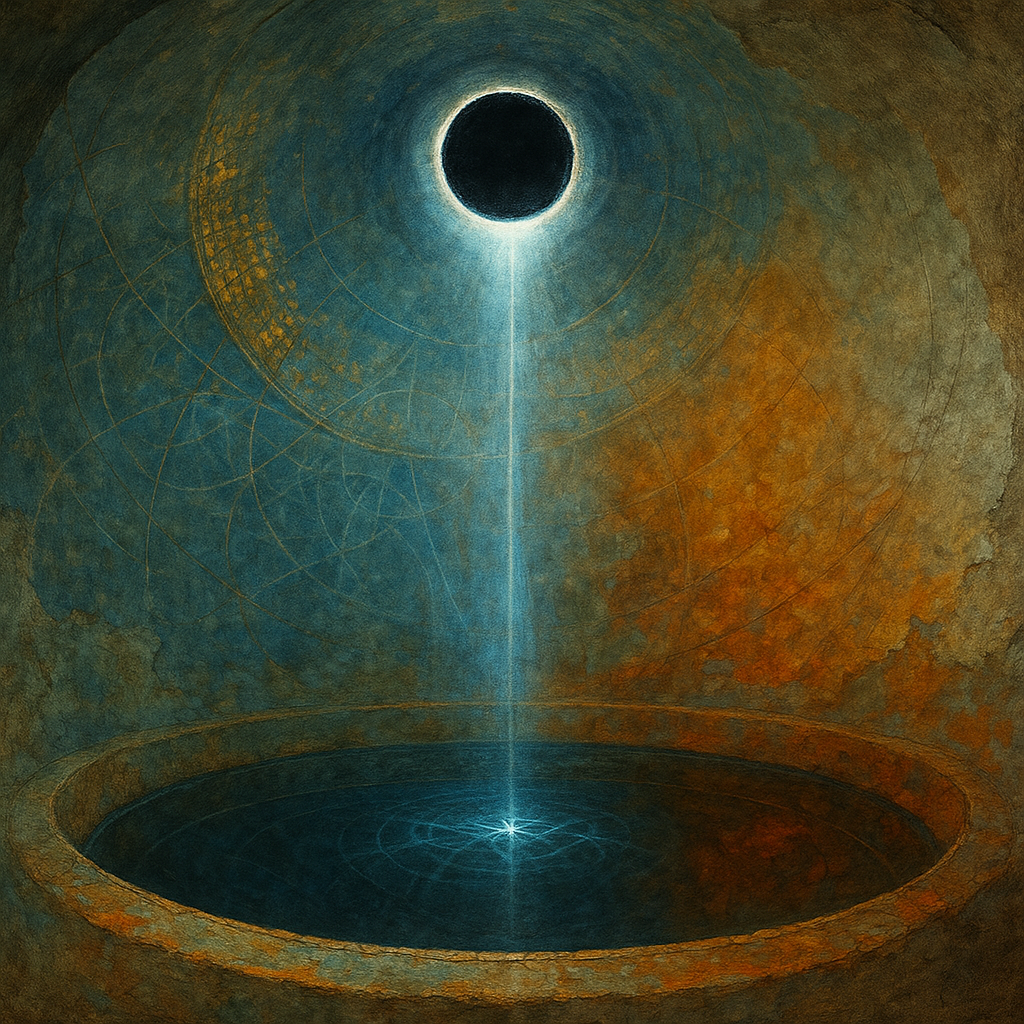
I placed a perfect hemisphere under a cold eclipse to test the Cosmos state: a black oculus with a blue-white corona and a vertical shaft that strikes a still, circular pool. Here the vault is stripped to hemisphere and oculus; the only ornament is motion — ripples and meridian ghosts — extracting the primitives of hemisphere, oculus, and mirror to show how perception fills a neutral curve. This frame captures the moment the upper void and its lower echo slip out of alignment, proving the same geometry can hold opposite readings without breaking its calm.
I hold a circle above and the same below.
Choose which is the sky; I keep both.
Scene Director
Fresco mural, ochre and verdigris pigments, crumbling plaster edges, dome interior, paradoxical shadow:
An off-center, low-angle view inside a vast, subterranean hemispherical dome, 30 meters wide, carved from living stone. The entire upper vault is stripped to its purest primitives: perfect, seamless curvature, broken only by the sharply defined oculus—a black eclipse haloed with a cold, cyan-white corona—that punches an icy, volumetric shaft straight down onto a still, circular pool of mirror-dark water below. Fresco textures dominate: the interior surface appears as weathered lime plaster, matte and cool, with visible brushstroke nap, hairline cracks, and crumbling, chipped boundaries where the pigment thins and underlying stone bleeds through. Edges of the mural are ragged, as if the perception itself is decaying at the borders.

A ribbon of faded ochre and blotched verdigris pigment lines the basin rim in the sharply focused foreground, worn to translucency in places, evoking both archaeological detritus and the afterimage of ritual. Across the mid-ground, the light cylinder is rendered as milky electric blue, seeded with flecks of pigment that mimic motes of dust suspended in chilly air—some granules appear to float above the plaster’s surface, invoking the fresco’s physicality. The reflected caustic lattice—ice-cyan and magnesium-white—dances up the undercurve of the dome, its knots flickering and splitting across tessellated gold mosaic patches embedded in the upper vault.

Each gold tessera is angled uniquely within the mural’s surface: some catch the upward caustic glint and blaze as if lit from below, while most shimmer with internal warmth. This impossible effect—tiles that glow with a molten, paradoxical radiance while the “lit” dome is icy blue—renders the entire vault as if it emits light, not merely reflects it. The mosaic’s uneven pattern echoes geological veining, further anchoring the space as something excavated, not built.

Paradoxical s